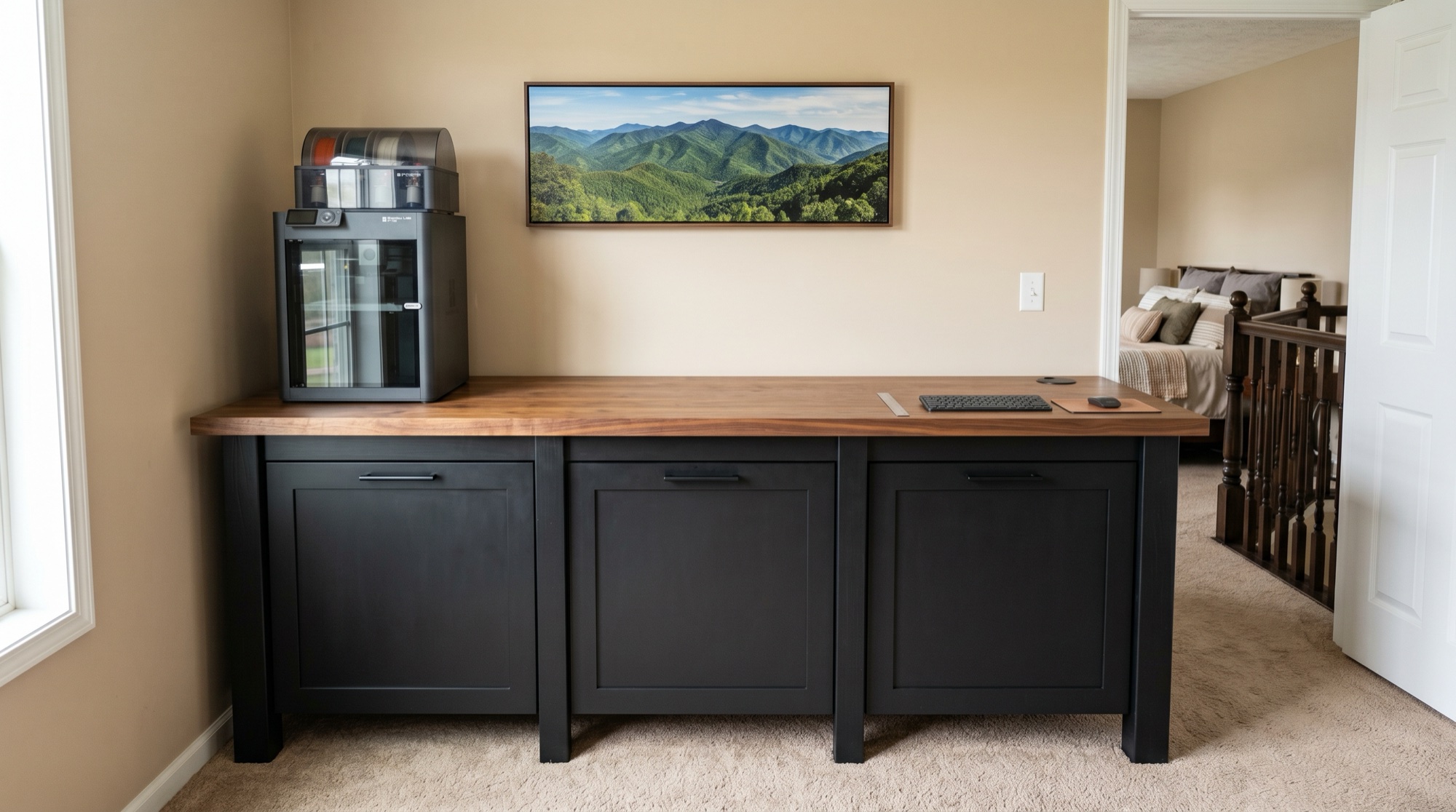
Build a wall-anchored standing workbench — the two-cabinet version
This is a guide to building one specific workbench for someone who is 6'9" tall: a 48-inch-tall, wall-anchored bench against the back wall of an upstairs bedroom office. The twist in this version — you buy the storage instead of building it. Two off-the-shelf YUKON 9-drawer steel tool cabinets sit on a short black plinth, the rest is black-paneled, and a single wood top runs across the whole thing. Less woodworking than building cabinets from scratch; a lot more drawers.
What you're building
A 48-inch-tall workbench that runs flush against the left wall and stops just shy of the bedroom door on the right. From the floor up:
- A ~9 3/8" black plinth — a stout, leveled wooden base that lifts the cabinets so the counter lands at standing height for someone 6'9".
- Two YUKON 9-drawer steel cabinets (Harbor Freight #56613), butted side by side, factory black. Eighteen drawers total. The plinth raises the lowest drawer ~9" off the floor — no crouching.
- A ~6" black-paneled end column on the door side that supports the right end of the top and hides the wall outlet and cord.
- A single IKEA wood top (98" × 25 5/8" × 1 1/2") across all of it, overhanging ~6" in front for knee clearance.
The whole stack is anchored to the wall studs with a lag-bolted ledger so it can't tip forward when you lean into it. Threaded levelers on the plinth corners keep it level on carpet.
"Plinth" just means a low base box. The cabinets are only 37" tall — too short for a 6'9" person's counter — so they ride on a ~9-inch wooden platform painted black to match. "Wall-anchored" means a board (the ledger) is lag-bolted into the 2x4s hidden in your wall, and the bench is tied to it so it can't pitch forward.
The cabinet
Each unit is a YUKON 46" 9-Drawer Mobile Storage Cabinet — welded steel, powder-coat black, ball-bearing drawer slides, on locking casters. Two of them replace the lens shelves, the general cabinet, and the rolling-tool-chest bay from the earlier design all at once.
Foam-line a few drawers for camera lenses and bodies. You see every lens from above, nothing stacks, and the two heavy-duty drawers (rated 200 lb) take the dense stuff. The old Husky rolling chest becomes redundant — its contents move into drawers.
Each cabinet weighs 186.5 lb. Getting two up an interior staircase is the hard part of this build. The move: pull every drawer out first (the empty shell is ~100 lb), carry the shells up with a helper and a strapped hand truck, and reinstall the drawers upstairs.
How to use this site
Before you start
There are a handful of things to confirm or measure before you spend any money — chief among them, measure a real cabinet before you cut the plinth, and verify the cabinets and top will make it up your stairs. They're listed on the reference page. Spend half an hour with a tape measure before you swipe a card.
The IKEA top at 98" × 25 5/8" × 1 1/2" is wood veneer over particleboard, not solid butcher block. It looks great and stays affordable, but you cannot get the cut edges wet, you cannot chop on it, and you should not put hot pans on it. If you want a true chop-safe work surface, upgrade to a solid acacia/maple butcher block at the same footprint — that's the one swap worth considering.